

.webp)
Trusted by Vancouver's Leading Brands
.svg)





.svg)
.svg)
.png)
We quote the job before we start
Homeowners and businesses alike trust WashTech for dependable service, year after year.







The glass itself. Mineral deposits and coastal salt spray bond to the surface over time and etch it. Etching is permanent, and restoration costs far more than a cleaning.
Your natural light. A film of pollen, road grime, and dried rain spotting cuts the light coming into a room, and it builds so gradually that most people stop noticing it.
Your frames, sills, and seals. Organic buildup holds moisture against gaskets and sills, which is the same mechanism that shortens their life anywhere else on the building.
Your curb appeal and leasing value. Storefront glass and strata common area windows are the first thing a customer or a prospective tenant looks through.
Your restoration budget. Once deposits bond to the surface, removing them stops being a cleaning job and becomes an acid restoration job, with no guarantee of full removal.
What our window cleaning services cover, and what sits outside the scope.
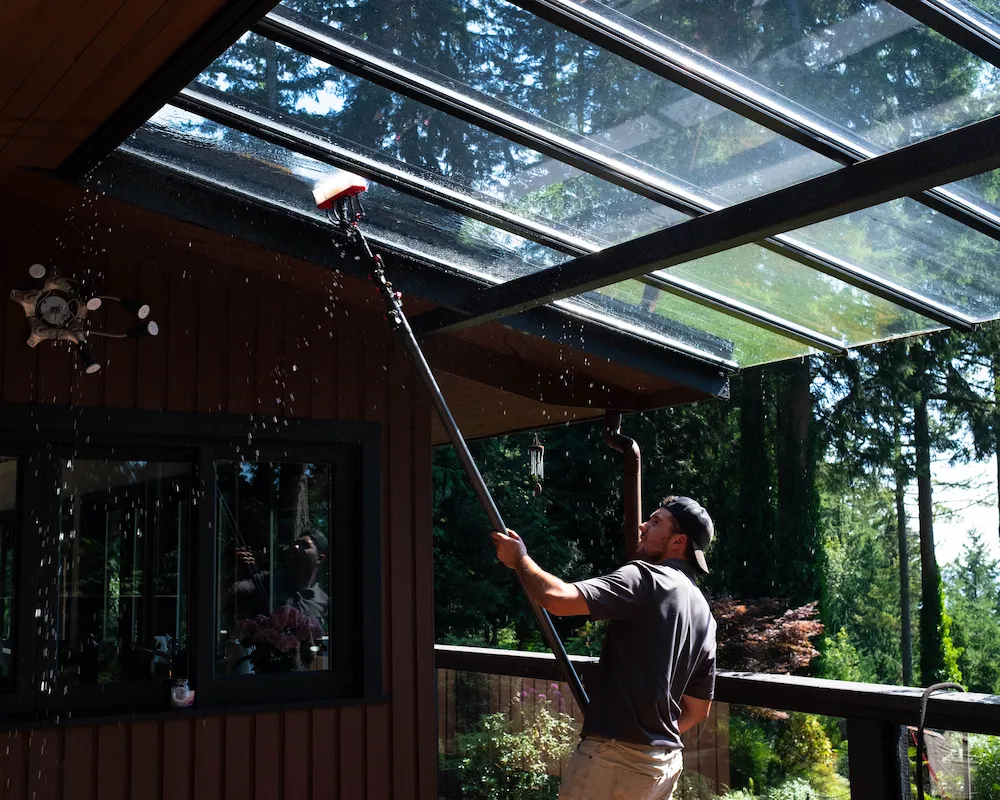
Our window cleaning services cover interior and exterior glass on residential, strata, and commercial properties. Interior panes are cleaned with squeegee and microfibre, with the frames wiped down. Exterior glass and frames are cleaned using a water fed pole system and rinsed with deionized water, which carries no dissolved minerals and therefore leaves nothing on the pane as it dries.
Before anything gets touched, we walk the property with you and the technician to check the glass for existing damage and agree on what the result will look like. Scratches, failed seals, and existing etching are identified and recorded at that point rather than discovered afterwards.
Priced separately, and quoted before we start:
That second list matters more on glass than on most exterior work, because a standard clean will not touch anything chemically bonded to the pane. Quoting it as window cleaning and then discovering overspray on site is how jobs turn into disputes. We would rather scope it correctly up front.
Metro Vancouver draws its water from mountain reservoirs rather than groundwater, which makes it unusually soft by Canadian standards. There is very little dissolved mineral content in it. That has two practical consequences for window cleaning here.
The first is that a deionized rinse works exceptionally cleanly in this region, because there is very little in the source water to remove before it goes on the glass. The second is more useful to know: when you do see hard water spotting on a Vancouver window, the tap water is usually not the cause. It tends to come from irrigation overspray, runoff off concrete or stucco above the window, or salt spray on waterfront properties in West Vancouver and Lions Bay. That changes what actually fixes it, and it is why we look at where the spotting sits on the pane before quoting anything.
Step 1
Step 2
Step 3
Step 4
Step 5
Step 6
More on keeping glass clear through a wet coastal year.
604-757-2016
.png)